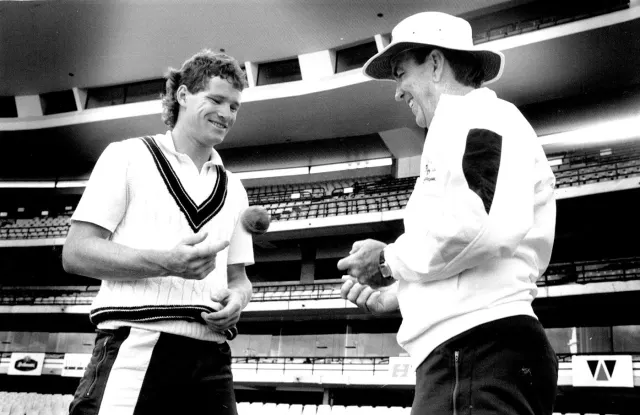
Australian Cricket Mourns the Loss of Legend Bob Simpson, Dead at 89
Australian cricket is in mourning following the passing of former captain, coach, and cricketing legend Bob Simpson, who died in Sydney at the age of 89. One of the most influential figures in the game’s history, Simpson leaves behind a legacy that helped shape the golden era of Australian cricket.
Simpson’s contribution to the sport spans across generations, having been a standout Test player, a pioneering full-time coach, and a mentor to some of Australia’s greatest cricketers.
A Storied Playing Career
Between 1957 and 1978, Simpson played 62 Test matches, scoring 4,869 runs at an average of 46.81 and taking 71 wickets with his legspin. He was also regarded as one of the finest slip fielders of his era. After making his first-class debut for New South Wales at just 16, he went on to compile 21,029 first-class runs and take 349 wickets.
Initially retiring in 1968 after captaining in 29 of his 50 Tests, Simpson made a dramatic return to the national side in 1977 during the World Series Cricket upheaval. At 41, he stepped in to lead a depleted Australian team through ten Tests against India and the West Indies, showcasing resilience and leadership in a turbulent period.
All ten of his Test centuries came while captaining, including a memorable 311 against England at Old Trafford in 1964. His partnership with Bill Lawry remains iconic, with their 382-run stand against West Indies in 1965 still the highest first-wicket partnership for Australia.
Mastermind Behind Australia’s Revival
Following his retirement as a player, Simpson's influence deepened as he took over as Australia’s first full-time coach in 1986. At the time, Australian cricket was struggling, having gone over two years without a series win.
Simpson, alongside captain Allan Border, rebuilt the team’s culture, emphasising discipline, fitness, and sharp fielding. Under his guidance, a new generation of Australian cricketers flourished — including the likes of Steve Waugh, Merv Hughes, Dean Jones, David Boon, and Craig McDermott.
His tenure oversaw a string of historic milestones:
-
1987: Australia won its first Cricket World Cup.
-
1989: The Ashes were reclaimed in England, beginning a 16-year stranglehold on the urn.
-
1995: Australia defeated the West Indies in the Caribbean, claiming the Frank Worrell Trophy for the first time in nearly two decades and earning the unofficial title of the world’s No. 1 Test side.
Simpson’s coaching legacy also includes mentoring future stars such as Shane Warne, Mark Waugh, Mark Taylor, Glenn McGrath, and Ricky Ponting. Warne credited Simpson for key tactical development early in his career, including encouraging the use of round-the-wicket angles.
Beyond Australia
After stepping down as Australia coach in 1996, Simpson continued to contribute globally. He coached Leicestershire and Lancashire in English county cricket, served as an advisor for India’s national team, and helped the Netherlands qualify for the 2007 World Cup.
Honours and Tributes
Simpson was named a Wisden Cricketer of the Year in 1965 and was inducted into both the ICC and Australian Cricket Halls of Fame. He was appointed a Member of the Order of Australia in 1978 and elevated to Officer (AO) in 2007 for his lifelong services to cricket.
Cricket Australia Chair Mike Baird paid tribute, saying:
"Bob Simpson was one of the greats of Australian cricket and this is a sad day for anyone fortunate to have watched him play or who benefited from his wisdom. His coaching laid the foundation for a golden era of Australian cricket."
End of an Era
Bob Simpson’s impact transcends statistics. As a player, leader, and coach, he defined resilience, innovation, and excellence. Australian cricket is richer because of him — and now deeply saddened by his passing.
He is survived by his family and by a legacy that helped define the sport for over half a century.