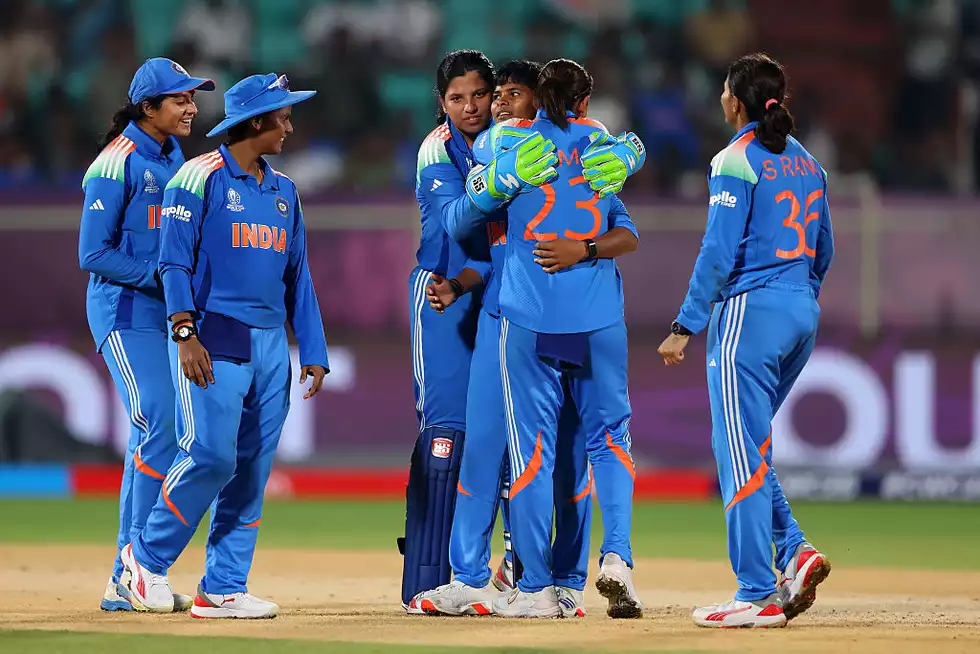
India Face Team Balance Dilemma Ahead of Crucial World Cup Clash Against Australia
As India prepare to take on Australia in a high-stakes ICC Women’s World Cup 2025 league clash on Sunday, a key question looms over team selection — should India persist with their deep batting line-up at the cost of a sixth bowling option?
The debate between batting depth and bowling variety is no longer theoretical. In modern-day white-ball cricket, a sixth bowling option has become less of a luxury and more of a necessity. That gap was exposed brutally in India’s recent match against South Africa, where the lack of an extra bowler allowed the visitors to mount a calculated chase, exploiting India’s inexperienced pace attack and spin-heavy bowling combination.
Since head coach Amol Muzumdar took over in late 2023, India have rarely fielded six genuine bowlers. The few times they have — including an ODI against Australia in New Chandigarh, which they won — were due to injury-enforced changes or pitch-specific tactics, not strategic planning. India’s preferred template in white-ball formats has remained a 5-1-5 combination: five batters, a wicketkeeper, and five bowlers, three of whom are all-rounders.
This formula, until recently, served India well. Since the 2022 ODI World Cup, India have registered an impressive 27-13 win-loss record in 41 matches, with only Australia posing consistent challenges. Much of that success came on the back of a formidable top five — led by vice-captain Smriti Mandhana, whose remarkable numbers (1646 runs at 63.3, SR 105.71 since June 2024) have made her a linchpin of the side.
But cracks have begun to appear.
In the opening three games of the World Cup, India’s vaunted top order faltered, putting immense pressure on the lower-middle order. Against Sri Lanka and Pakistan, India lost clusters of wickets despite strong starts, slumping to 124/6 and 159/5, respectively. Against South Africa in Vizag, they were reduced to 102/6 before Richa Ghosh’s stellar 94 lifted them to a competitive 251 — a total South Africa overhauled with ease, thanks to the calculated late assault against India’s limited bowling attack.
Despite early rain and sluggish pitches, the famed top order has struggled to adapt. While Pratika Rawal and Harleen Deol have been among the top scorers, their low strike rates have often left India short of imposing totals. The more experienced trio of Mandhana, Jemimah Rodrigues, and Harmanpreet Kaur are yet to make a significant impact in the tournament.
What’s been surprising — and encouraging — is the resilience shown by India’s lower order. In all three matches, batters from No. 6 to No. 9 have outperformed the top order, both in averages and strike rates. The statistics are telling:
| Batters | Runs | Avg | SR | 50s | 4/6s | Boundary % | Dot % |
|---|---|---|---|---|---|---|---|
| Top-five | 347 | 23.13 | 69.81 | 0 | 40/3 | 8.65% | 60.9% |
| No. 6 to 9 | 365 | 36.5 | 96.05 | 3 | 34/9 | 11.31% | 46.5% |
This unexpected lower-order success has made it difficult for the team management to justify changes in the all-rounder core. Players like Amanjot Kaur and Renuka Thakur, despite recent injuries, have shown their value as both bowlers and handy contributors with the bat.
However, the balance issue has become impossible to ignore, especially as India head into their most important group game yet — against six-time champions Australia. With a fully fit squad to choose from, Sunday’s match in Vizag could define India’s campaign trajectory.
There is a growing consensus that India must now rethink their combination — possibly at the expense of a pure batter — to accommodate a sixth bowler and restore tactical flexibility. This would mean relying on their top-five batters to deliver consistently, as the cushion of extra depth down the order can no longer be the fallback plan against stronger teams.
Even as rain and pitch conditions continue to play a role, the team's inability to adapt quickly has led to missed opportunities. India can no longer afford to wait for reputations to turn into match-winning performances. The time has come for bold selection calls.
As the team faces their sternest test yet, the spotlight is firmly on the think tank to strike the right balance — between power and prudence, depth and discipline, faith and form. Whether India have the conviction to make the tough decisions could well determine their fate in the tournament.