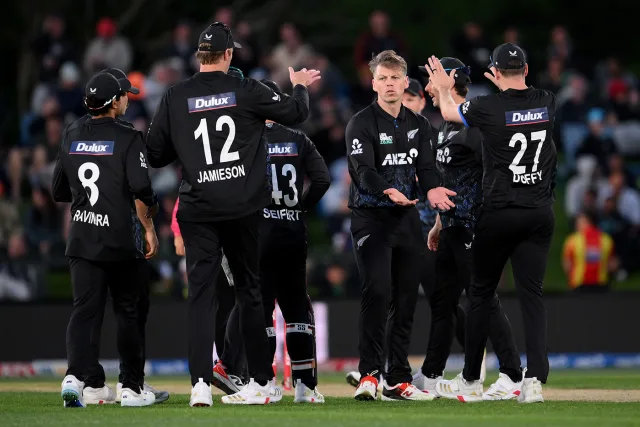
Bracewell Progressing Well as New Zealand Gear Up for Varied World Cup Conditions
New Zealand allrounder Michael Bracewell is on track to return from a calf injury in time for the ICC Men’s T20 World Cup, with head coach Rob Walter confirming the 33-year-old’s recovery is progressing well ahead of the tournament.
Bracewell missed New Zealand’s recent five-match T20I series against India but is expected to test his match fitness in the Black Caps’ warm-up fixture against the United States in Mumbai, three days before their World Cup opener against Afghanistan in Chennai.
“I mean his progression has been really good and he’s made good progress,” Walter said. “Certainly everything seems to be on track for the warm-up game against USA.”
Despite spending nearly three weeks in India, New Zealand were unable to field their strongest XI consistently during the T20I series due to injuries and player unavailability. They came close to a full-strength side late in the series, but illness ruled Jimmy Neesham out while the team opted not to rush Lockie Ferguson back from injury, once again disrupting their balance.
Neesham, who has not played for New Zealand since November 2025, has remained active on the franchise circuit, featuring in the Bangladesh Premier League and the ILT20 in the UAE—conditions Walter believes closely resemble those in India and Sri Lanka, the two World Cup host nations.
“Jimmy, who was a bit ill at the back end of this competition, was obviously very much involved in the Bangladesh Premier League all the way through to winning a final,” Walter said. “So our guys have been very active from a T20 point of view… from a preparation point of view, I don’t feel like we can really feel to be unready.”
New Zealand have also been boosted by the form of Finn Allen, who arrived in India fresh from a record-breaking Big Bash League campaign with Perth Scorchers, where he struck 38 sixes—the most in a single BBL season. Allen carried that power-hitting form into the series against India, scoring a blistering 80 off 38 balls, including an aggressive assault on mystery spinner Varun Chakravarthy.
“You would expect the conditions to be very different in Australia to India,” Walter said. “The question always is whether form transfers from venue to venue. We certainly saw that happen.”
Further encouragement came from the return of Ferguson, who made his comeback in the fifth T20I after recovering from a calf injury sustained during the ILT20. The fast bowler made an immediate impact, striking twice at high pace on a flat pitch to remove Abhishek Sharma and Sanju Samson. With Adam Milne ruled out of the World Cup, Ferguson is expected to play a key enforcer’s role, aided by his recently developed knuckle ball.
“He worked incredibly hard to get himself ready,” Walter said. “He said he was going to ease into it, but he was bowling 145. If that’s easing in, I’m looking forward to what’s to come.”
The final T20I against India produced a combined 496 runs—the second-highest aggregate in T20I history—and the series overall was marked by consistently high scores. However, Walter expects conditions and match dynamics to vary once the World Cup begins.
“I think [scores] could be varied,” he said. “When there’s more on the line, intent changes. That being said, overall scores in T20 cricket have increased, and the way the Indian batters played in this series was extremely impressive.”
New Zealand will play three of their four group-stage matches at Chepauk Stadium in Chennai, all of them day games: against Afghanistan on February 8, UAE on February 10, and Canada on February 17. The venue recently underwent an outfield relaying, and with no competitive cricket played there since IPL 2025, conditions remain uncertain.
Captain Mitchell Santner expressed confidence in the team’s ability to adapt.
“We’ve had a few players who’ve played at Chennai in the IPL over the years,” Santner said. “Day games will be different, and we’ll have to reset our clocks. But it’s another challenge, and we pride ourselves on adapting quickly.”
New Zealand will also contend with contrasting surfaces during the tournament, warming up on red soil at DY Patil Stadium before switching to black-soil pitches in Chennai—a test of flexibility the side believes it is well equipped to handle.