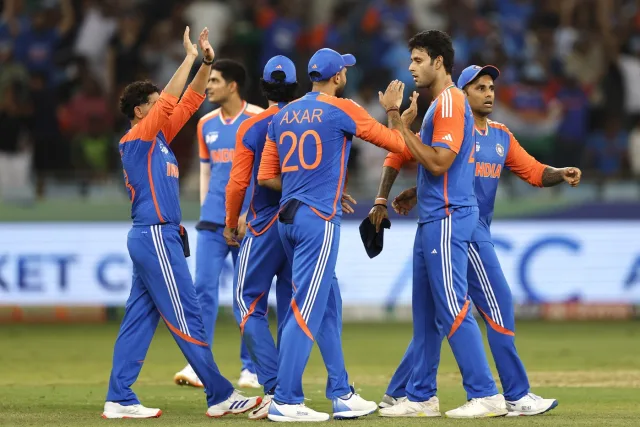
Kumble and du Plessis worried about India's sixth bowling option
Former India captain Anil Kumble and South Africa batter Faf du Plessis have raised concerns over India’s sixth bowling option and lack of role clarity despite the team’s commanding win over Zimbabwe in Chennai to keep their semi-final hopes alive at the ICC Men's T20 World Cup.
India posted a dominant performance with the bat and ball, but questions linger over the balance of the side ahead of their crucial clash against West Indies on Sunday. While the hosts have relied on five frontline bowlers — Arshdeep Singh, Jasprit Bumrah, Varun Chakravarthy, Hardik Pandya and Axar Patel — the sixth bowling role remains unsettled.
Shivam Dube has largely filled that position, with part-time contributions coming from Abhishek Sharma, Tilak Varma and Rinku Singh. However, Dube’s returns have been expensive. In 9.2 overs during the tournament, he has conceded 124 runs at an economy rate of 13.28, albeit picking up five wickets.
Speaking on ESPNcricinfo’s TimeOut show, Kumble said India had deliberately developed multiple bowling options over the past 18 months but warned that flexibility alone may not be enough on flat surfaces.
“They certainly did all the right things to get the batters to bowl a bit through the previous World Cup to now,” Kumble said. “If you look at the last 18 months, Tilak Varma, Abhishek Sharma, Dube, even Rinku Singh and Suryakumar Yadav have bowled. So in that sense, you have options and that’s great. But on a flat pitch, there will be challenges.”
Kumble added that India would ideally prefer the security of playing eight recognised batters rather than compromising the balance with only seven batters and five specialist bowlers.
Du Plessis echoed those concerns, suggesting that opposition teams would identify India’s sixth bowling option as a pressure point. He believes teams will aim to negotiate India’s primary threats, particularly Bumrah and Varun, and target the less experienced options.
“You look at it and ask: who are the danger bowlers? Most of the time, it’s Bumrah,” Du Plessis said. “If you can get on top of someone else early, then the sixth bowling option is going to have to come in. If that happens and he is bowling defensive lines, you can line him up.”
The debate over team balance comes amid frequent changes to India’s playing XI. Against South Africa, Axar Patel was replaced by Washington Sundar to introduce a right-arm off-spin option. In the Zimbabwe game, Sanju Samson was brought in to break up a left-handed-heavy top order, while Ishan Kishan shifted to No. 3 and Tilak Varma was pushed down to No. 6.
Tilak responded emphatically with an unbeaten 44 off 16 balls, guiding India to a formidable 256 for 4. However, Du Plessis noted that constant reshuffling could hinder clarity within the batting unit.
“The team they would have planned before the World Cup and where they find themselves now feels very different from a role perspective,” he said. “There’s a lot of movement in terms of role play and if you look at the teams that are doing well, it’s a very set batting line-up.”
Kumble agreed, pointing out that while India boast a long batting order, defined responsibilities remain fluid.
“That’s something India haven’t really been able to manage,” Kumble said. “Someone like Axar coming in at eight gives you depth, but the role clarity hasn’t been there — whether it’s Tilak at three earlier or now possibly at five or six depending on the situation.”
With West Indies having already demonstrated their firepower — including a 254 for 6 against Zimbabwe — India’s bowling combination and tactical clarity could prove decisive as the tournament enters its knockout phase.